

Wedding Bouquet Shapes Explained: Posy, Nosegay, Cascade and More
A wedding bouquet is a piece of engineering as much as it is a piece of styling. The flowers get the attention, but the shape decides whether you look comfortable in photographs, whether the bouquet finishes your dress or fights it, and whether you are still happy to be holding it at the end of the vows. Silhouette, scale and stem length all do quiet work. Here is how the main shapes behave, and where each one tends to earn its place.
Start with proportion, not flowers
The most common mistake is falling for a colour palette and a list of varieties before thinking about scale. A bouquet sits against the widest part of your dress, usually at the waist or hip, and it is judged against your body rather than against the bucket it was built in.
A useful rule of thumb: a round bouquet should be roughly the width of your shoulders, or slightly narrower, and a compact posy should not extend past the bodice. Sleeves, beading and statement necklines add visual weight, so the bouquet often needs to be either simpler or fuller to hold its own. Understated dresses can carry more texture without looking fussy. If you are petite, a heavy cascade can overwhelm you; if you are tall, a tiny posy can vanish in wide shots.
The posy: round, compact, endlessly useful
The posy is the shape most people picture when they imagine a wedding bouquet. Flowers are arranged into a tight dome, usually about 20–25cm across, with the stems trimmed short and hidden. It is built either in concentric rings or as a spiralled hand-tied bunch, and it photographs beautifully from above, which matters more than you might think when the confetti shots begin.
It suits fitted bodices, A-line and tea-length dresses, lace sleeves, village churches, register offices and marquee receptions. Above all, it is light. If you have small hands, a long aisle to walk or you have never carried flowers before, a posy is the kind choice. A soft, garden-grown version with looser stems and a little movement feels more relaxed than a tightly domed one, even though the outline is the same.
The nosegay and the hand-tied sheaf
Strictly speaking, a nosegay was a small bunch of scented flowers carried close to the face, historically to mask other smells. Today the word describes a small, dense, highly structured round bunch, often wired so every flower head sits exactly where the florist wants it, finished with a collar of leaves and a neatly bound handle. It reads as formal and vintage, and it is the shape to choose if scent matters to you: lily of the valley, sweet peas, narcissi and old-fashioned garden roses all carry beautifully in a nosegay.
The hand-tied sheaf sits at the opposite end of the scale. Stems are left long and bound low, so the flowers sit above your hands and the bouquet looks gathered rather than arranged. It is the easiest shape to carry at your side and the most forgiving in heat, because nothing is wired into a rigid structure. An armful of long-stemmed blooms suits relaxed, outdoorsy weddings and dresses without much embellishment.
The cascade: drama for the aisle
A cascade, sometimes called a shower bouquet, is built as a teardrop with flowers and foliage trailing downwards. The shape fell out of fashion for a while and has returned in a looser, garden-led form, with trailing jasmine, clematis or amaranthus rather than rigid tiers of orchids.
It needs a dress that can match its confidence: ballgowns, princess lines and mermaid silhouettes all work, as do cathedral aisles, high-ceilinged churches and venues with long sightlines. Cascades add height and movement in photographs and give you something to do with your hands while you wait. The trade-offs are weight, heat tolerance and handling. Ask your florist how the trailing stems are secured and how the bouquet is kept fresh through a long day, and practise holding it in the position you would actually carry it. If you have to grip it with both hands for the whole ceremony, the shape is wrong.
Single stems, crescents and other alternatives
Not every bride wants a bouquet in the traditional sense, and the alternatives are genuinely practical rather than just fashionable.
- Single stem: one generous bloom, such as a dahlia, peony or sunflower, held on its own. Minimal, modern, and almost weightless. Good for city weddings, second marriages or heavily embellished dresses.
- Crescent: a curved shape that hugs the arm. Elegant with sleeveless and off-the-shoulder dresses.
- Basket or hoop: flowers arranged in a shallow basket or on a hoop. Useful for outdoor ceremonies and for brides who want their hands free.
- Dried or preserved bunch: holds its shape indefinitely and suits winter weddings and industrial venues, though it will not match fresh buttonholes.
Matching shape to dress, venue and season
By dress and venue
- Ballgown or princess line: cascade or a generous hand-tied sheaf. A small posy will look lost against the volume.
- Sheath or column: compact posy, single stem or slim sheaf, kept close to the body.
- Mermaid or fishtail: a cascade repeats the line; a round posy balances the flare.
- A-line or tea-length: almost anything works. Aim for mid-size.
- Vintage, lace or long sleeves: nosegay, dense and scented.
- Cathedral, abbey or grand hall: scale up. Cascades and long-stemmed sheaves hold their own in big spaces.
- Registry office, city venue, pub reception: guests and cameras stay close, so texture and detail matter more than size.
By season
Spring flowers such as tulips, ranunculus and narcissi move and bend, which suits a loose sheaf more than a tightly wired dome. Summer brings peonies, dahlias, sweet peas and garden roses at their best, so a posy or nosegay shows them off with minimal fuss. Autumn berries, seed heads and dahlias take beautifully to a mid-size hand-tied. In winter, think amaryllis, hellebores, anemones, evergreens and dried elements, which hold structure well in a nosegay or compact posy. Trailing flowers wilt fastest in heat, so if you are marrying in July, keep the trail short or choose something woody.
Putting it into practice
Before you commit, ask your florist to make a mock-up at the agreed size and hold it yourself, ideally in front of a mirror, in the shoes you plan to wear. Check three things: the weight after twenty minutes, whether you can walk and greet people without adjusting it, and whether the stems and handle feel comfortable in your grip.
Bring photographs of the dress, the venue and any bridesmaid dresses, plus your own measurements, so scale can be judged properly rather than guessed. Tell your florist about allergies in the wedding party, and about anything you particularly dislike, from heavy scent to exposed stems. Decide early whether you want stems wrapped in ribbon, left natural or finished with a pin, because it changes how the whole bouquet reads in close-up shots. Book a smaller version for bridesmaids, and ask where the bouquet should live between the ceremony and the speeches; a jug of cool water and a shaded spot will keep it looking sharp into the evening.
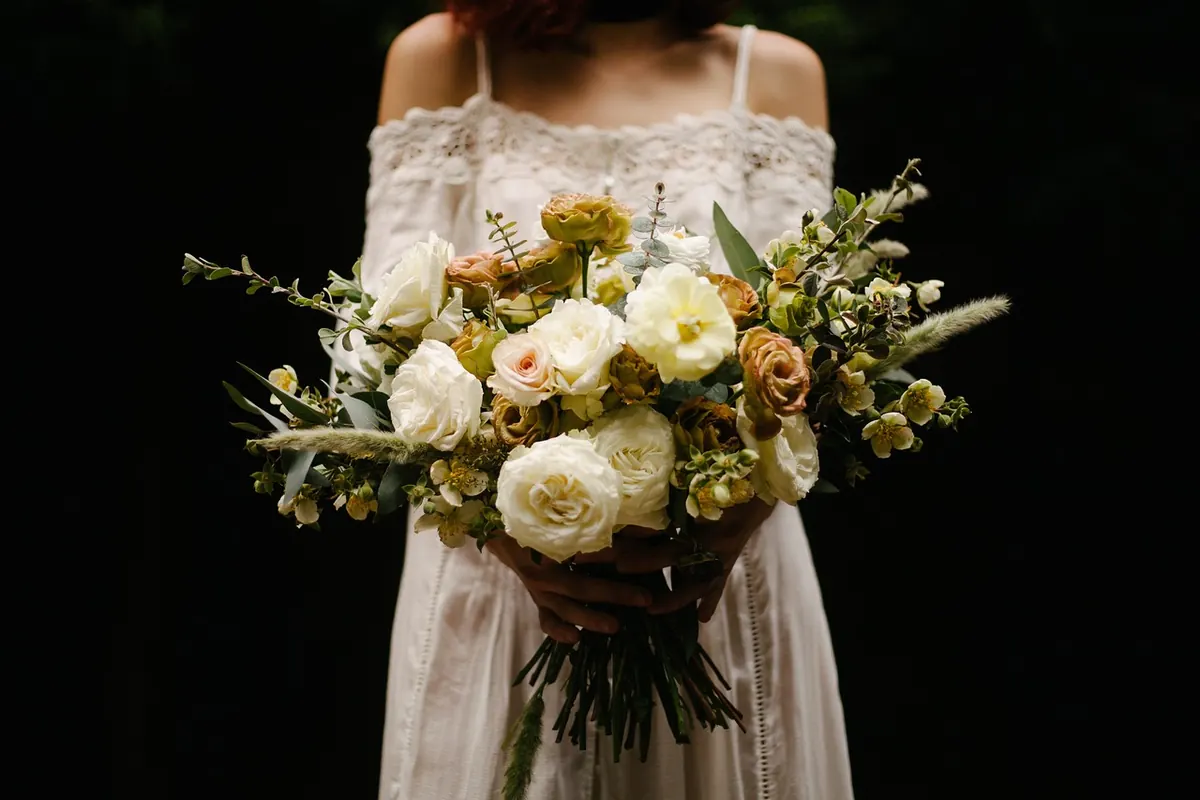
Photo: StockSnap / Pixabay